10 preguntas de selección múltiple · Dificultad: Mixto · Unidad: Language in Use: gramática y vocabulario en contexto. Elige una alternativa y revisa la explicación.
Pregunta 1FácilComprender
Complete the dialogue with the correct words:
"______ you ever ______ to the south of Chile?" "Yes, I have. I went to Valdivia last year."
Ver respuesta y explicación
Respuesta correcta: A. Para preguntar sobre experiencias de vida en Present Perfect con el pronombre 'you', utilizamos el auxiliar 'Have' seguido del participio pasado del verbo, que en este caso es 'been' (participio de 'be').
Pregunta 2FácilAplicar
Complete the sentence using the correct First Conditional structure:
"If we ______ trash on the beach, we ______ the ocean."
Ver respuesta y explicación
Respuesta correcta: B. La estructura del primer condicional es 'If + Present Simple (leave), will + infinitivo (will pollute)'. Se utiliza para expresar una causa real en el presente y su consecuencia en el futuro.
Pregunta 3FácilComprender
Choose the correct sentence to express that Camila has NOT had the experience of seeing a condor in real life.
Ver respuesta y explicación
Respuesta correcta: A. La estructura correcta para la tercera persona singular (Camila) en Present Perfect es 'has + never + past participle (seen)'. La opción D es incorrecta porque produce una doble negación ('hasn't never').
Pregunta 4IntermedioAnalizar
Read the environmental campaign slogan:
"If we don't protect the Araucaria forests, they ____________ disappear forever."
What is the correct word to complete this future consequence?
Ver respuesta y explicación
Respuesta correcta: B. En el Primer Condicional, la cláusula de resultado o consecuencia real en el futuro utiliza el verbo modal 'will' seguido del verbo en infinitivo ('disappear').
Pregunta 5IntermedioAnalizar
Read the dialogue between Lucas and Sofía and choose the correct option to complete it:
Lucas: "Have you ever eaten empanadas de pino?" Sofía: "Yes, I __________ them many times, but I __________ one last Sunday."
Ver respuesta y explicación
Respuesta correcta: A. Para hablar de una experiencia general sin un tiempo específico, usamos Present Perfect ('have eaten'). Para referirnos a un momento específico en el pasado ('last Sunday'), usamos Past Simple ('ate').
Pregunta 6IntermedioInterpretar
De acuerdo con la imagen adjunta, observe the image representing a student studying at home. Based on her actions, which sentence correctly expresses a cause and consequence using the First Conditional?
Ver respuesta y explicación
Respuesta correcta: A. La opción A sigue perfectamente la estructura del primer condicional: 'If' + Present Simple ('studies') para la condición, y 'will' + infinitivo ('will pass') para el resultado futuro.
Pregunta 7DifícilEvaluar
Read the conversation between two friends planning a trip to San Pedro de Atacama:
Tomás: "I want to visit the Valley of the Moon. Have you ever _______ there?" Francisca: "No, I have never _______ to the north, but my sister has _______ some beautiful photos of it."
Which option correctly completes all three spaces with the appropriate past participles?
Ver respuesta y explicación
Respuesta correcta: A. En el Present Perfect, todas las formas verbales principales deben estar en participio pasado. 'Been' es el participio de 'be' (usado para indicar haber visitado un lugar) y 'taken' es el participio de 'take' (usado para fotos).
Pregunta 8DifícilSintetizar
Read the sentence:
"If we don't start recycling our plastic bottles, the landfills in Chile will overflow soon."
Which of the following options has the exact same meaning but uses a different conditional structure?
Ver respuesta y explicación
Respuesta correcta: A. La palabra 'Unless' significa 'a menos que' (equivalente a 'if... not'). Por lo tanto, 'Unless we start recycling' equivale gramaticalmente y en significado a 'If we don't start recycling'.
Pregunta 9DifícilAnalizar
Read the paragraph:
"My family has never traveled by train, but we want to visit Chillán. If we save enough money this year, we __________ tickets for the 'Tren Central'."
Choose the option that correctly completes the sentence and explains why.
Ver respuesta y explicación
Respuesta correcta: A. Se requiere el primer condicional ('will buy') porque la cláusula 'If we save enough money' (Present Simple) plantea una condición real y probable en el presente, cuya consecuencia ocurrirá en el futuro.
Pregunta 10DifícilEvaluar
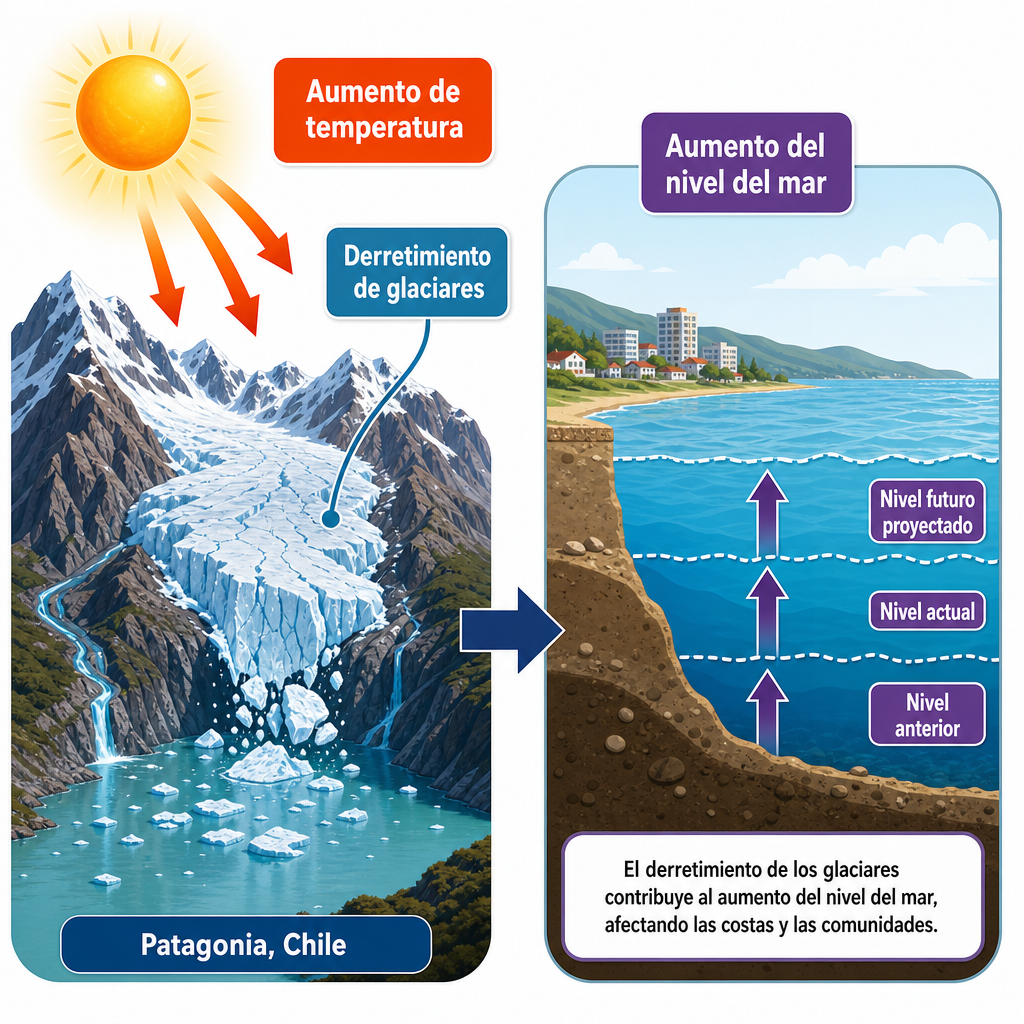
De acuerdo con la imagen adjunta, look at the diagram showing global warming and its consequences on glaciers. According to the cause-and-effect relationship shown in the image, which sentence is grammatically correct and logically true?
Ver respuesta y explicación
Respuesta correcta: A. La opción A representa correctamente la causa científica y la estructura del primer condicional: 'If' + Present Simple ('rise') para la causa, y 'will' + infinitivo ('will melt') para la consecuencia futura.