10 preguntas de selección múltiple · Dificultad: Mixto · Unidad: Speaking & Interaction. Elige una alternativa y revisa la explicación.
Pregunta 1FácilIdentificar
During a class game of 'Find Someone Who...', you want to know if a classmate watched a movie yesterday. What is the correct question to ask them?
Ver respuesta y explicación
Respuesta correcta: B. To form questions in the Past Simple for interactive games like 'Find Someone Who...', we use 'Did' + subject + verb in its base form ('watch'). Option D is a common mistake because it uses both 'did' and the past form '-ed' together.
Pregunta 2FácilDiscriminar
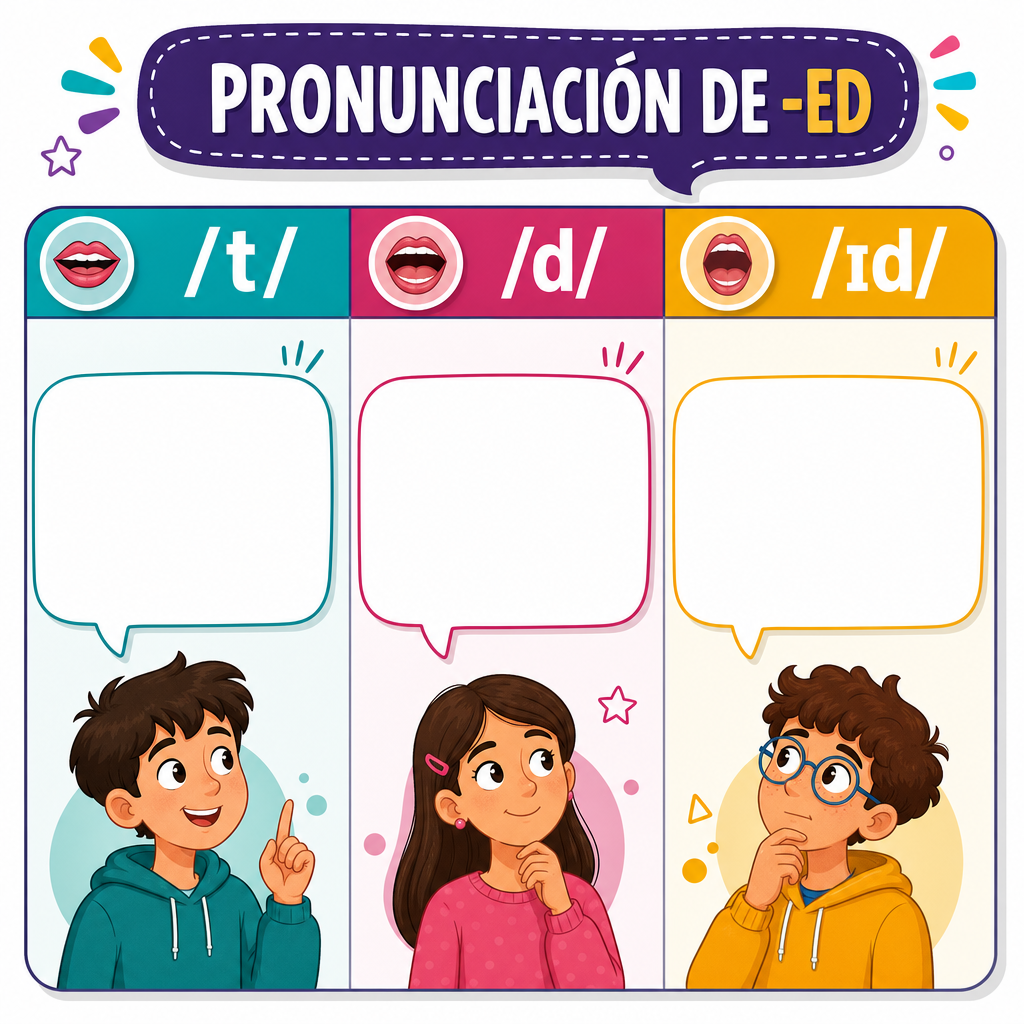
De acuerdo con la imagen adjunta, in English, the '-ed' ending of regular past tense verbs can sound like /t/, /d/, or /ɪd/. Look at the pronunciation chart. Which of the following verbs has an '-ed' ending that sounds like /ɪd/ (extra syllable)?
Ver respuesta y explicación
Respuesta correcta: C. Verbs that end in the sounds /t/ or /d/ (like 'want') add an extra syllable pronounced as /ɪd/ in the past tense ('wanted'). 'Played' ends in /d/, while 'liked' and 'watched' end in /t/.
Pregunta 3FácilAplicar
Imagine you are playing 'Find Someone Who...' in your English class. A classmate asks you: 'Did you listen to music this morning?'. What is the most natural and grammatically correct short answer to keep the interaction going?
Ver respuesta y explicación
Respuesta correcta: A. The standard and natural short answer to a Past Simple question starting with 'Did' is 'Yes, I did' or 'No, I didn't'.
Pregunta 4IntermedioClasificar
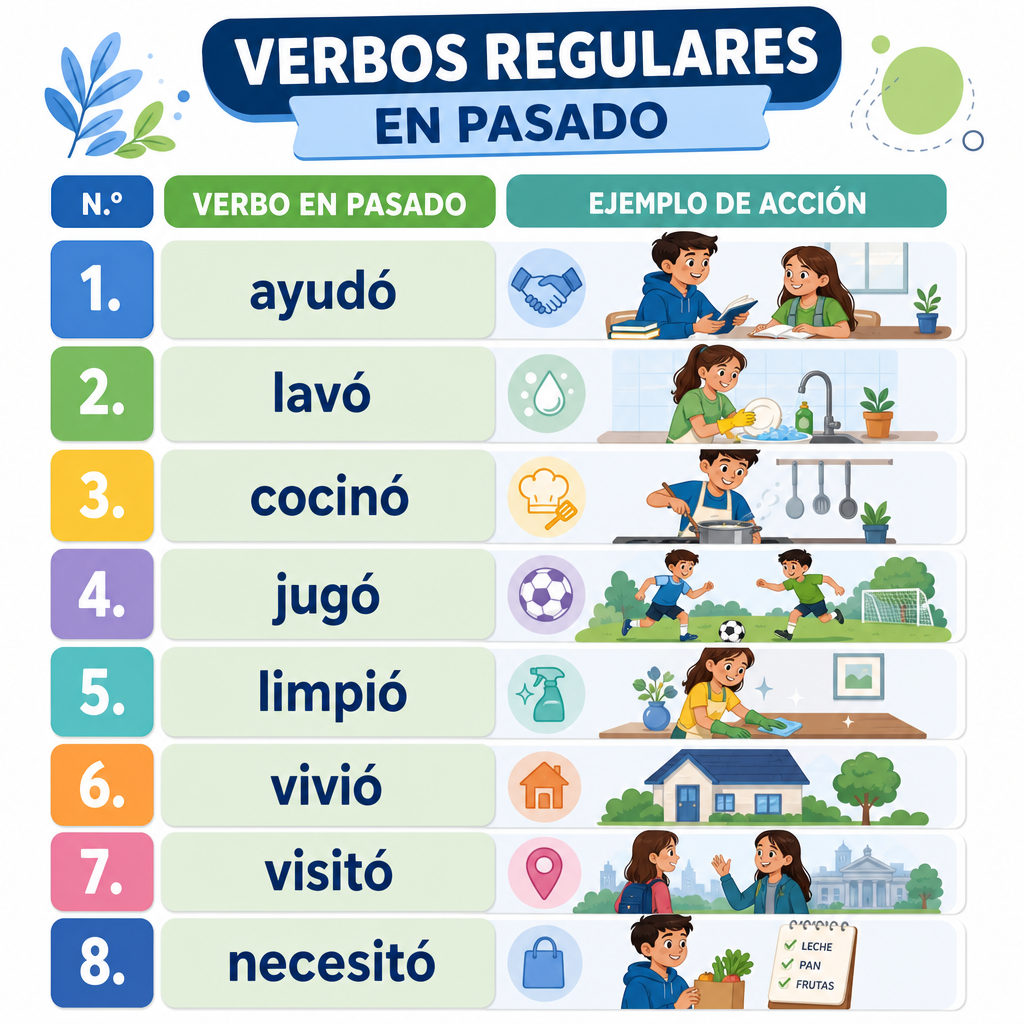
De acuerdo con la imagen adjunta, look at the list of regular verbs in the image. If you group them by the pronunciation of their '-ed' endings, which group contains ONLY verbs where the '-ed' is pronounced as /t/?
Ver respuesta y explicación
Respuesta correcta: A. Verbs ending in voiceless consonant sounds like /p/ (help), /ʃ/ (wash), and /k/ (cook) take the /t/ pronunciation for their '-ed' ending. Therefore, 'helped', 'washed', and 'cooked' all end in the /t/ sound.
Pregunta 5IntermedioAnalizar
During an oral presentation, your teacher asks you a surprise question: 'What did you do last weekend?'. Which of the following answers shows good spontaneous interaction and correct grammar?
Ver respuesta y explicación
Respuesta correcta: B. To answer a question about the past spontaneously and correctly, all verbs describing past actions must be in the past tense ('went' and 'played').
Pregunta 6IntermedioAplicar
You are playing a speaking game where you must find someone who did certain activities. You want to ask Benjamín if he cleaned his room. Which of the following options has the correct pronunciation for the ending of 'cleaned' and the correct question format?
Ver respuesta y explicación
Respuesta correcta: A. The question must use the base form of the verb ('clean') after 'Did'. When pronouncing the past tense 'cleaned', the '-ed' sounds like /d/ because 'clean' ends in a voiced 'n' sound.
Pregunta 7DifícilEvaluar
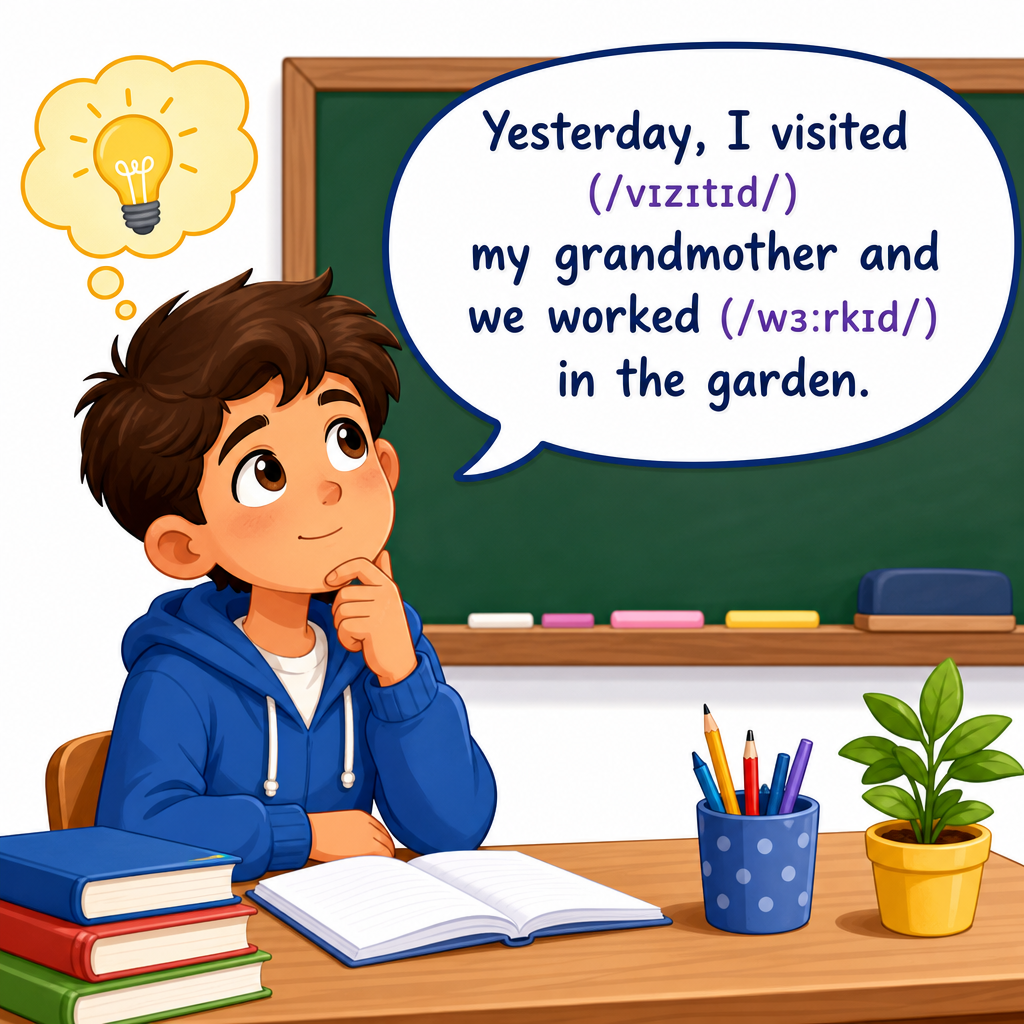
De acuerdo con la imagen adjunta, during a classroom speaking game, a student is trying to pronounce past tense verbs. Look at the conversation bubble in the image. Which feedback from the options below is correct regarding their pronunciation of 'visited' and 'worked'?
Ver respuesta y explicación
Respuesta correcta: B. The verb 'visit' ends in a 't' sound, so 'visited' is pronounced with /ɪd/ (vi-si-ted). However, 'work' ends in a voiceless 'k' sound, so 'worked' must be pronounced with a /t/ sound (workt), not /ɪd/.
Pregunta 8DifícilArgumentar
To keep an interaction natural during a surprise Q&A session after a presentation, what is the best strategy when you do not understand a question asked by your classmate?
Ver respuesta y explicación
Respuesta correcta: C. Spontaneous interaction involves using repair and clarification strategies. Asking for repetition or clarification in English keeps the communication flow active and natural.
Pregunta 9DifícilAnalizar
Read the following dialogue from a 'Find Someone Who' game:
Player A: Did you danced pop music last weekend? Player B: Yes, I did! I love dancing.
What is the grammatical error in Player A's question and how should it be corrected to improve speaking accuracy?
Ver respuesta y explicación
Respuesta correcta: C. In Past Simple questions, the auxiliary verb 'did' indicates the past tense, so the main verb must remain in its base form ('dance' instead of 'danced').
Pregunta 10DifícilDiscriminar
During a pronunciation game, your teacher asks you to group verbs that end with the voiced sound /d/. Which of the following groups contains ONLY verbs whose '-ed' ending is pronounced as /d/?
Ver respuesta y explicación
Respuesta correcta: A. The '-ed' ending is pronounced /d/ when the base verb ends in a voiced sound (like vowels in 'play', 'm' in 'climb', or 'v' in 'love'). Group B contains /t/ endings, Group C contains /ɪd/ endings, and Group D contains a mix of /d/ and /t/ endings.