10 preguntas de selección múltiple · Dificultad: Mixto · Unidad: Advanced Grammar & Vocabulary. Elige una alternativa y revisa la explicación.
Pregunta 1FácilComprensión lectora
Choose the correct relative pronoun to complete the sentence: 'The programmer ______ designed this green app is from Chile.'
Ver respuesta y explicación
Respuesta correcta: B. We use 'who' (or 'that') as a relative pronoun when we are referring to people. In this case, 'the programmer' is a person, so 'who' is the correct choice.
Pregunta 2FácilComprensión lectora
Read the sentence and choose the correct phrasal verb to complete it: 'I don't know how to solve this environmental problem, but I will try to _______ a solution.'
Ver respuesta y explicación
Respuesta correcta: A. The phrasal verb 'figure out' means to find a solution to a problem or to understand something after thinking about it. This fits perfectly in the context of solving an environmental problem.
Pregunta 3FácilUso de la lengua
Complete the sentence with the correct relative pronoun: 'This is the eco-friendly office ______ they develop solar panels.'
Ver respuesta y explicación
Respuesta correcta: C. We use the relative pronoun 'where' to refer to a place. Since 'the eco-friendly office' is a location where an action takes place, 'where' is the correct option.
Pregunta 4IntermedioUso de la lengua
De acuerdo con la imagen adjunta, according to the diagram shown in the image, select the sentence that correctly uses a non-defining relative clause to describe the solar panel setup.
Ver respuesta y explicación
Respuesta correcta: A. A non-defining relative clause adds extra, non-essential information and must be separated from the rest of the sentence by commas. 'The solar panel, which was set up on the roof, converts...' correctly uses commas and the relative pronoun 'which' to describe an object, matching the context of the solar panel installation.
Pregunta 5IntermedioComprensión lectora
Read the conversation between two classmates:
- Lucas: 'I finally ________ the courage to talk to the new IT teacher.' - Sofia: 'Great! She is the person ________ launched the school's recycling app.'
Which option correctly completes the blanks?
Ver respuesta y explicación
Respuesta correcta: C. 'Build up' means to gradually increase or accumulate (in this case, courage). The second blank refers to 'the person', so the relative pronoun 'who' is required.
Pregunta 6IntermedioUso de la lengua
Identify the sentence that correctly combines these two thoughts using a defining relative clause: 'He is a hard-working entrepreneur. He set up a technology startup last year.'
Ver respuesta y explicación
Respuesta correcta: B. A defining relative clause identifies exactly which person we are talking about and does not use commas. Since 'entrepreneur' is a person, we use 'who' without commas.
Pregunta 7DifícilComprensión lectora
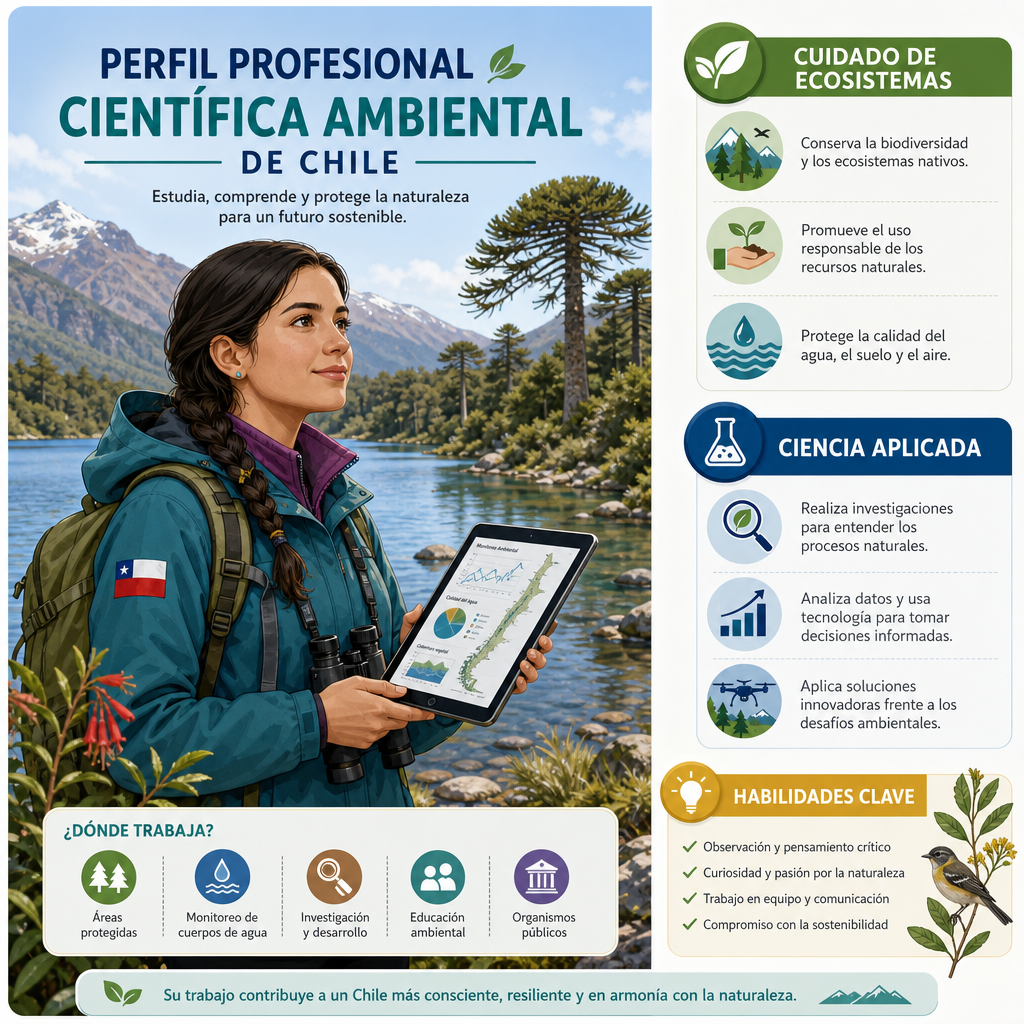
De acuerdo con la imagen adjunta, look at the career profile infographic. Which sentence correctly describes the professional's duties using a relative clause and a phrasal verb?
Ver respuesta y explicación
Respuesta correcta: A. Option A correctly uses a non-defining relative clause with commas to add extra information about her demanding job, and uses the phrasal verb 'look after' (cuidar/proteger) which fits the role of an environmental scientist.
Pregunta 8DifícilUso de la lengua
Read the paragraph about a young Chilean innovator:
'Matías, ______ is only 15 years old, has developed an app that helps people reduce food waste. He decided to never ______ on his project, even when the coding got extremely difficult.'
Choose the option that grammatically and contextually fits the blanks.
Ver respuesta y explicación
Respuesta correcta: C. The first blank requires a non-defining relative clause because 'Matías' is a specific proper noun, meaning we need a comma before 'who' (', who'). The second blank requires the phrasal verb 'give up' (rendirse), which fits the context of persisting with the project.
Pregunta 9DifícilUso de la lengua
Which of the following sentences is grammatically INCORRECT regarding the use of relative clauses and phrasal verbs?
Ver respuesta y explicación
Respuesta correcta: D. This sentence is incorrect because 'which' is used for objects or animals, but it is referring to 'The scientist' (a person). It should use 'who' or 'whom'. Also, the phrasal verb 'look forward to' must be followed by a gerund ('meeting') instead of an infinitive ('meet').
Pregunta 10DifícilComprensión lectora
Analyze the sentence: 'The team of young volunteers, who look forward to cleaning the beaches of Pichilemu, set up a recycling station yesterday.'
What is the main function of the non-defining relative clause in this sentence?
Ver respuesta y explicación
Respuesta correcta: B. The clause 'who look forward to cleaning the beaches of Pichilemu' is non-defining (enclosed in commas). Its function is to provide extra, non-essential details about the volunteers' enthusiasm, rather than defining which specific group they are.