10 preguntas de selección múltiple · Dificultad: Mixto · Unidad: Listening & Media Literacy. Elige una alternativa y revisa la explicación.
Pregunta 1FácilIdentificar
When taking notes during a fast-paced academic lecture or TED Talk, which of the following practices is most effective for saving time without losing information?
Ver respuesta y explicación
Respuesta correcta: B. Using abbreviations and symbols is a core academic note-taking skill that allows students to keep up with the speed of spoken English during lectures or presentations without missing key concepts.
Pregunta 2FácilAnalizar
During a listening comprehension class, you hear a speaker pronounce words like 'water' as [wahtah] and 'better' as [bettah], dropping the 'r' sound at the end of words. Which regional English accent is most likely being featured?
Ver respuesta y explicación
Respuesta correcta: B. Dropping the post-vocalic 'r' (making it non-rhotic) is a distinct feature of standard Southern British (RP) and Australian English, unlike General American or Scottish English where the 'r' is pronounced.
Pregunta 3FácilRepresentar
De acuerdo con la imagen adjunta, look at the student's note-taking mind map in the image. What is the main relationship represented between 'Tech Dev.' and 'Job Market'?
Ver respuesta y explicación
Respuesta correcta: B. In the mind map, the arrow points from 'Tech Dev.' to 'Job Market' with a plus/minus sign, indicating that technological development directly impacts or causes changes (both positive and negative) in the job market.
Pregunta 4IntermedioEvaluar
You are watching a documentary about human rights in South Africa. The narrator speaks with a distinctive South African English accent, characterized by pronouncing the 'i' sound in words like 'sit' or 'pin' closer to an 'uh' sound ('sut', 'pun'). What strategy should you use to ensure high comprehension of the arguments?
Ver respuesta y explicación
Respuesta correcta: B. When dealing with unfamiliar non-standard accents, active listeners rely on context clues, visual support from the media, and overall sentence prosody rather than getting stuck on single phonetic variations.
Pregunta 5IntermedioAnalizar
Listen to this transcript excerpt from a global technology conference speaker: 'Our main goal is not just to build faster processors, but to democratize access to education through digital tools.' What is the speaker's primary purpose?
Ver respuesta y explicación
Respuesta correcta: C. The speaker explicitly states that the main goal is 'to democratize access to education through digital tools', which directly aligns with advocating for educational equity.
Pregunta 6IntermedioRepresentar
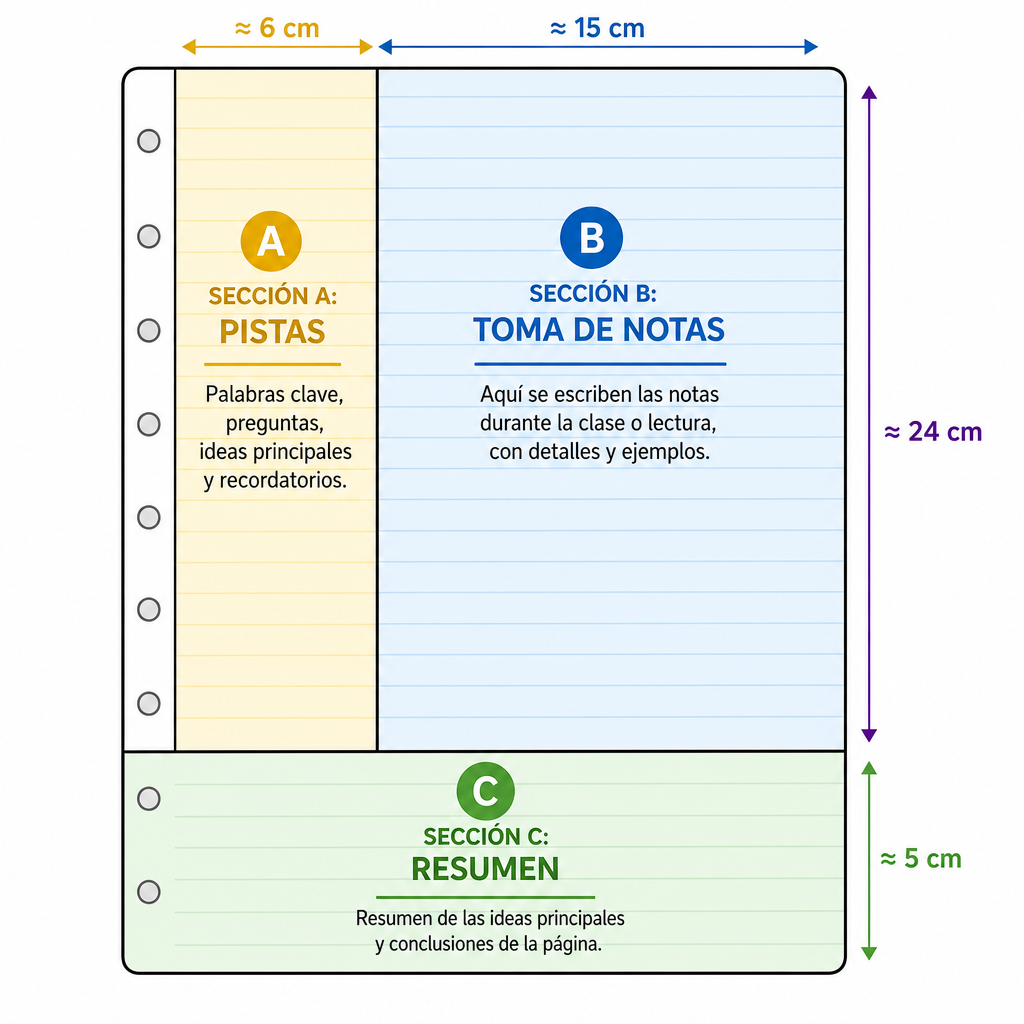
De acuerdo con la imagen adjunta, observe the Cornell Note-taking template shown in the image. If you are listening to a lecture about renewable energy, in which section of the template should you write your main abbreviations and bullet points during the actual listening phase?
Ver respuesta y explicación
Respuesta correcta: B. In the classic Cornell Note-taking system, Section B (the large right column) is used to record the actual notes, details, and bullet points during the lecture, while Section A is for keywords/questions after the lecture, and Section C is for the summary.
Pregunta 7DifícilArgumentar
An Indian speaker in a TED Talk on climate change states: 'We must act now; otherwise, the agricultural sector will face devastating losses.' A student takes notes and writes: 'Agri. sector → loss if no action.' Which of the following best evaluates the student's note-taking strategy?
Ver respuesta y explicación
Respuesta correcta: C. The note accurately captures the logical relationship of cause and effect (no action leads to agricultural loss) using efficient shorthand, which is the primary goal of academic note-taking.
Pregunta 8DifícilAnalizar
During a panel discussion on global human rights, you notice a speaker using a Scottish accent, pronouncing 'out' as [oot] and 'right' with a very sharp, tapped /r/. Despite the pronunciation differences, the speaker maintains a serious, urgent tone and uses words like 'violating', 'fundamental rights', and 'immediate intervention'. What is the critical takeaway regarding the speaker's message?
Ver respuesta y explicación
Respuesta correcta: B. In global communication, understanding non-standard accents is crucial. The speaker's regional accent does not diminish the academic weight or the urgent tone of their message, which is identified through key vocabulary and prosody.
Pregunta 9DifícilModelar
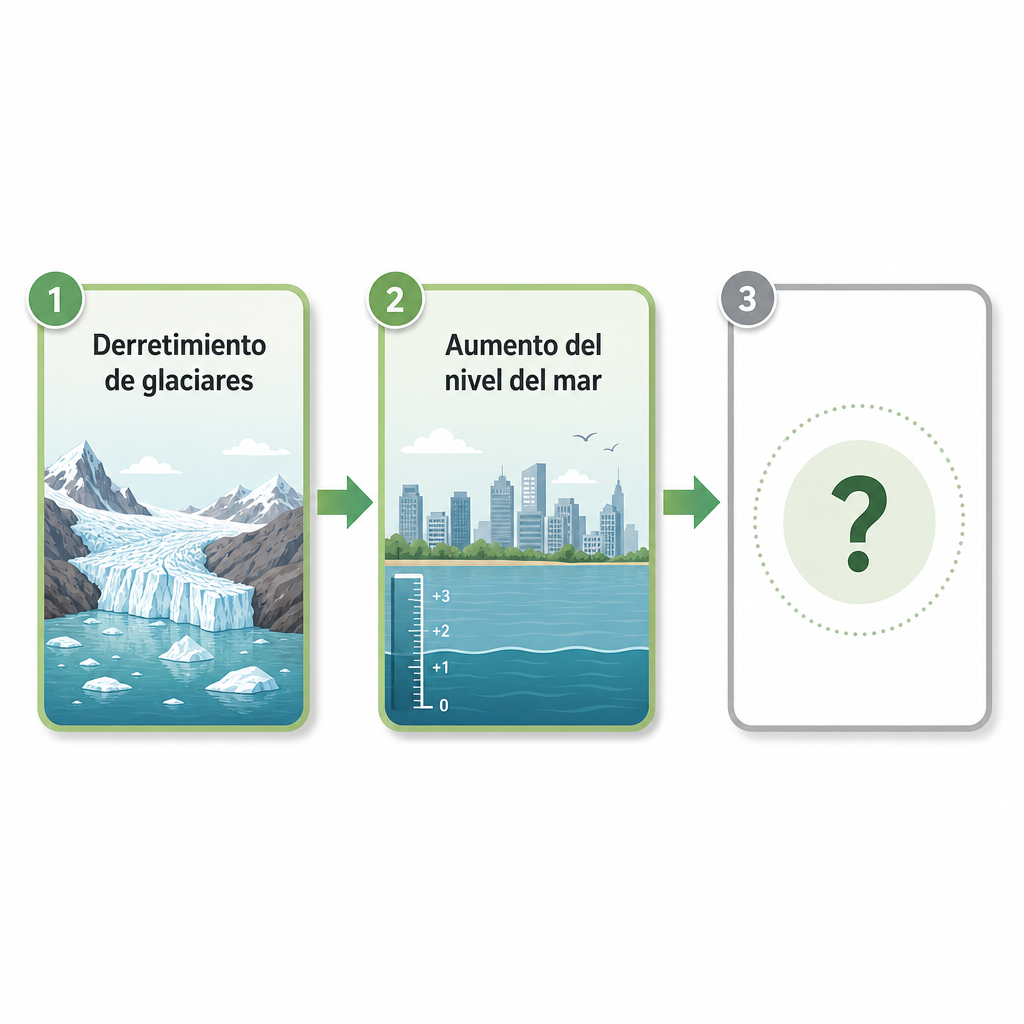
De acuerdo con la imagen adjunta, look at the flow chart in the image representing a speaker's argument in a science documentary. Which of the following options best completes the empty box (marked with a '?') based on logical academic flow?
Ver respuesta y explicación
Respuesta correcta: C. In a logical environmental chain of events, 'Glacier melting' leads to 'Sea level rise', which directly causes the 'Loss of coastal biodiversity' due to flooding and habitat destruction.
Pregunta 10DifícilAnalizar
A student is listening to a podcast about artificial intelligence. The Australian host says: 'We cannot simply let algorithms decide human fates without oversight.' The student notes down: 'AI decisions = dangerous.' Why is this note partially inaccurate or biased?
Ver respuesta y explicación
Respuesta correcta: B. Effective academic note-taking must capture the nuance of arguments. The host is warning against unsupervised AI decisions ('without oversight'), not stating that all AI decisions are inherently and equally dangerous.