Test: Formal correspondence and academic writing devices
10 preguntas de selección múltiple · Dificultad: Mixto · Unidad: Writing: Argumentation & Academic English. Elige una alternativa y revisa la explicación.
Pregunta 1FácilComprender y aplicar
When writing a cover letter for a university admission program in Chile or abroad, which of the following is the most appropriate salutation to use if you do not know the recipient's name?
Ver respuesta y explicación
Respuesta correcta: B. In formal correspondence, when the name of the recipient is unknown, 'To Whom It May Concern' or 'Dear Sir/Madam' are the standard and appropriate formal salutations. The other options are too informal or casual for a university admission cover letter.
Pregunta 2FácilComprender y aplicar
Read the following sentence: 'The results prove that the new educational program is a complete success.' How can you rewrite this sentence using hedging (academic caution) to make it sound more objective?
Ver respuesta y explicación
Respuesta correcta: B. Hedging involves using cautious language to avoid making absolute or overgeneralized claims. Using verbs like 'suggest' and modal verbs like 'may' softens the claim, making it academically appropriate and cautious.
Pregunta 3FácilComprender y aplicar
Which of the following sentences uses a cleft sentence structure to emphasize that 'determination' (and not luck) is the key to academic success?
Ver respuesta y explicación
Respuesta correcta: C. The structure 'It is/was + [emphasized element] + that/relative clause' is an 'it-cleft' sentence. It is used in academic writing to place specific focus and emphasis on a particular noun phrase, in this case, 'determination'.
Pregunta 4IntermedioAnalizar
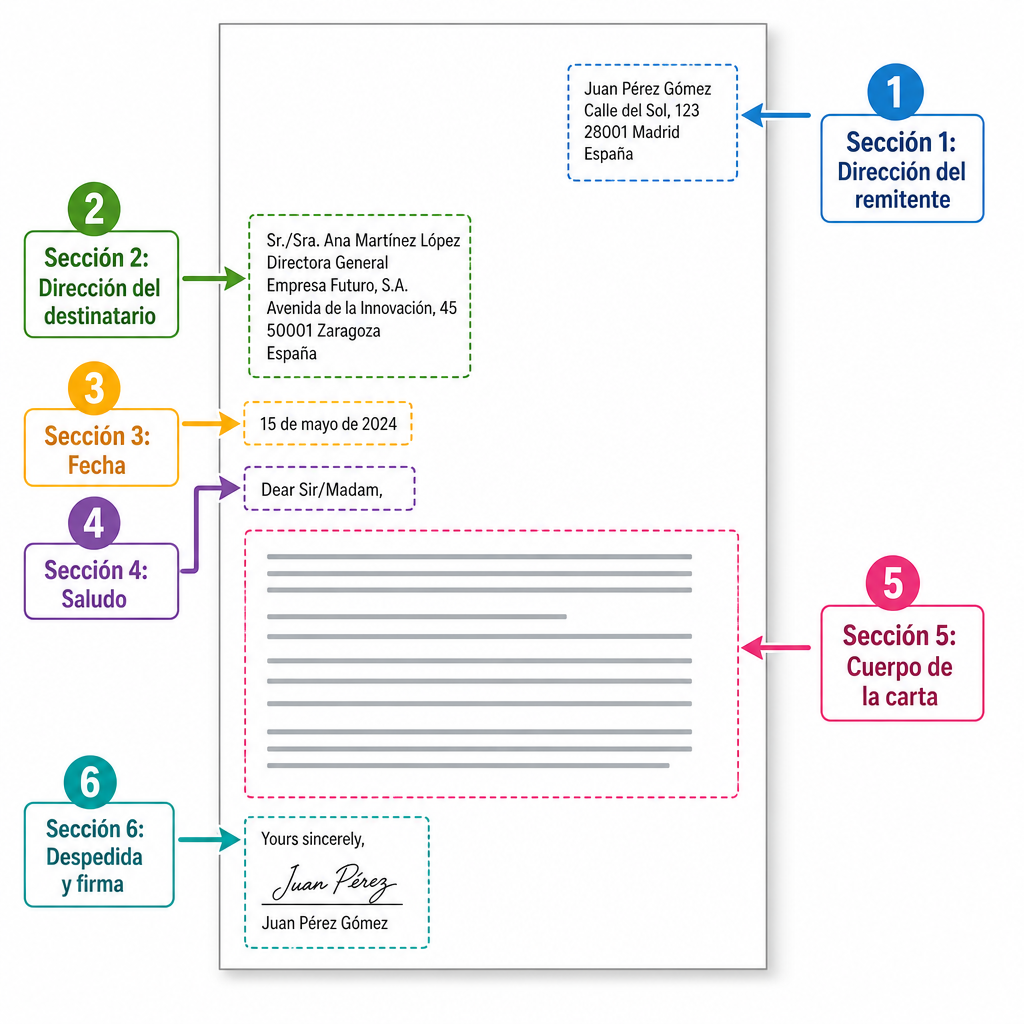
De acuerdo con la imagen adjunta, you are writing a cover letter to apply for an exchange scholarship in Canada. Examine the layout and components of a standard formal letter shown in the diagram. According to the structure, which section is incorrectly placed?
Ver respuesta y explicación
Respuesta correcta: B. In standard formal letter layouts (such as block format), the Date (Section 3 in the diagram) should be placed at the very top or directly below the Sender's Address, before the Recipient's Address. Placing it between the Recipient's Address and the Salutation is incorrect.
Pregunta 5IntermedioComprender y aplicar
In academic writing, absolute statements like 'Technology isolates teenagers' are discouraged. Which of the following options rewrites this statement using appropriate hedging devices?
Ver respuesta y explicación
Respuesta correcta: B. The phrase 'Evidence suggests that...' combined with the modal verb 'may' and the verb 'contribute to' are classic academic hedging devices that replace absolute claims with cautious, defensible formulations.
Pregunta 6IntermedioAnalizar
Read this paragraph from a student's draft cover letter:
'I really want this job because I am super good at organizing events and my friends say I'm very responsible. Also, I need to get this scholarship to pay for my studies.'
Which of the following is the best revision to improve the register and make it suitable for a formal academic application?
Ver respuesta y explicación
Respuesta correcta: B. Option B uses formal vocabulary ('highly interested', 'demonstrated responsibility', 'academic pursuits'), avoids informal colloquialisms ('super good', 'my friends say', 'awesome'), and maintains a professional tone suitable for an academic application.
Pregunta 7DifícilAnalizar
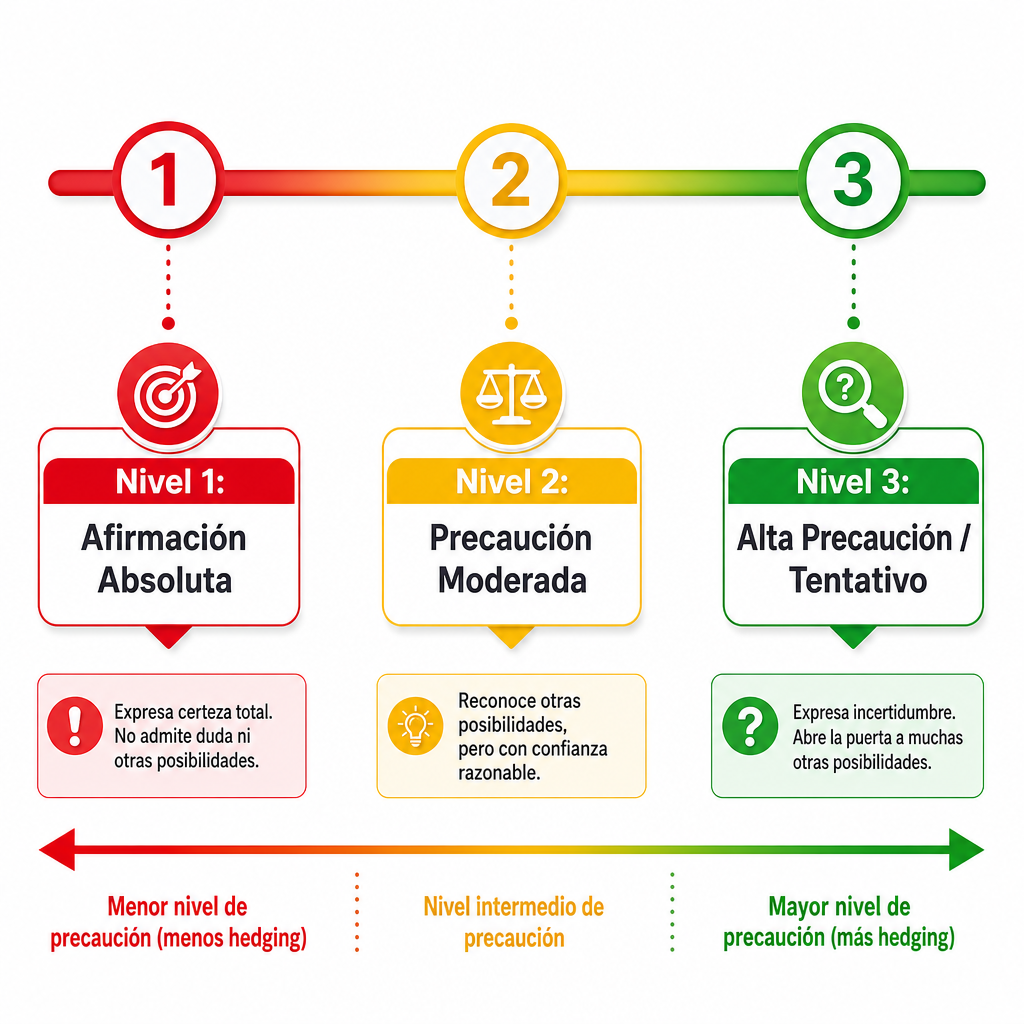
De acuerdo con la imagen adjunta, look at the visual scale of academic certainty in the image. Based on this scale, which sentence would be placed at the highest level of 'Academic Caution / Hedging' (under point 3, representing the most cautious and tentative claim)?
Ver respuesta y explicación
Respuesta correcta: C. Option C uses multiple hedging devices ('would seem to suggest', 'could potentially', 'under certain conditions'), making it the most cautious, tentative, and non-absolute statement. This corresponds to the highest level of academic caution (hedging).
Pregunta 8DifícilComprender y aplicar
You want to emphasize that the main obstacle to sustainable development in Latin America is the lack of public funding, and not the lack of interest. Which of the following 'What-cleft' sentences achieves this emphasis most effectively and grammatically?
Ver respuesta y explicación
Respuesta correcta: B. A 'What-cleft' sentence begins with a noun clause introduced by 'What'. Option B correctly uses this structure ('What hinders... is...') to contrast 'lack of interest' with 'lack of public funding', placing the academic emphasis exactly where intended.
Pregunta 9DifícilAnalizar
Analyze the following sentence from an academic essay: 'The implementation of the new curriculum will lead to better standardized test scores.' Which of the following options introduces modality and hedging to make this statement acceptable for a peer-reviewed academic journal?
Ver respuesta y explicación
Respuesta correcta: C. In academic writing, claims must be cautious. Option C uses 'there is a possibility' and the modal 'could' to soften the claim, transforming an absolute prediction into a nuanced, academically sound hypothesis.
Pregunta 10DifícilComprender y aplicar
Choose the option that successfully combines a cleft sentence for emphasis with appropriate hedging (academic caution) in a single sentence suitable for a cover letter.
Ver respuesta y explicación
Respuesta correcta: A. Option A uses an 'it-cleft' structure ('It is my background... that...') to emphasize the applicant's experience, while incorporating the hedging phrase 'I believe' to maintain a professional, persuasive, yet humble tone (avoiding the arrogant 'absolute best' of option C).