10 preguntas de selección múltiple · Dificultad: Mixto · Unidad: Reading & Literature. Elige una alternativa y revisa la explicación.
Pregunta 1FácilComprender
Read the following short blog post:
'The Atacama Desert in northern Chile is now home to thousands of solar panels. This area receives some of the highest solar radiation in the world, making it the perfect place for clean energy. Many local communities are starting to benefit from this cheap and sustainable power source.'
What is the main idea of this text?
Ver respuesta y explicación
Respuesta correcta: B. El texto explica que el Desierto de Atacama es ideal para la energía solar debido a su alta radiación y que las comunidades locales se están beneficiando de esta fuente de energía limpia, lo que hace que la opción B sea la idea principal.
Pregunta 2FácilAnalizar
Read the following sentences about social media. Which of them is a FACT rather than an opinion?
Ver respuesta y explicación
Respuesta correcta: B. La opción B presenta un hecho comprobable basado en datos estadísticos de un estudio, mientras que las otras opciones expresan juicios de valor, preferencias personales o recomendaciones subjetivas (opiniones).
Pregunta 3FácilComprender
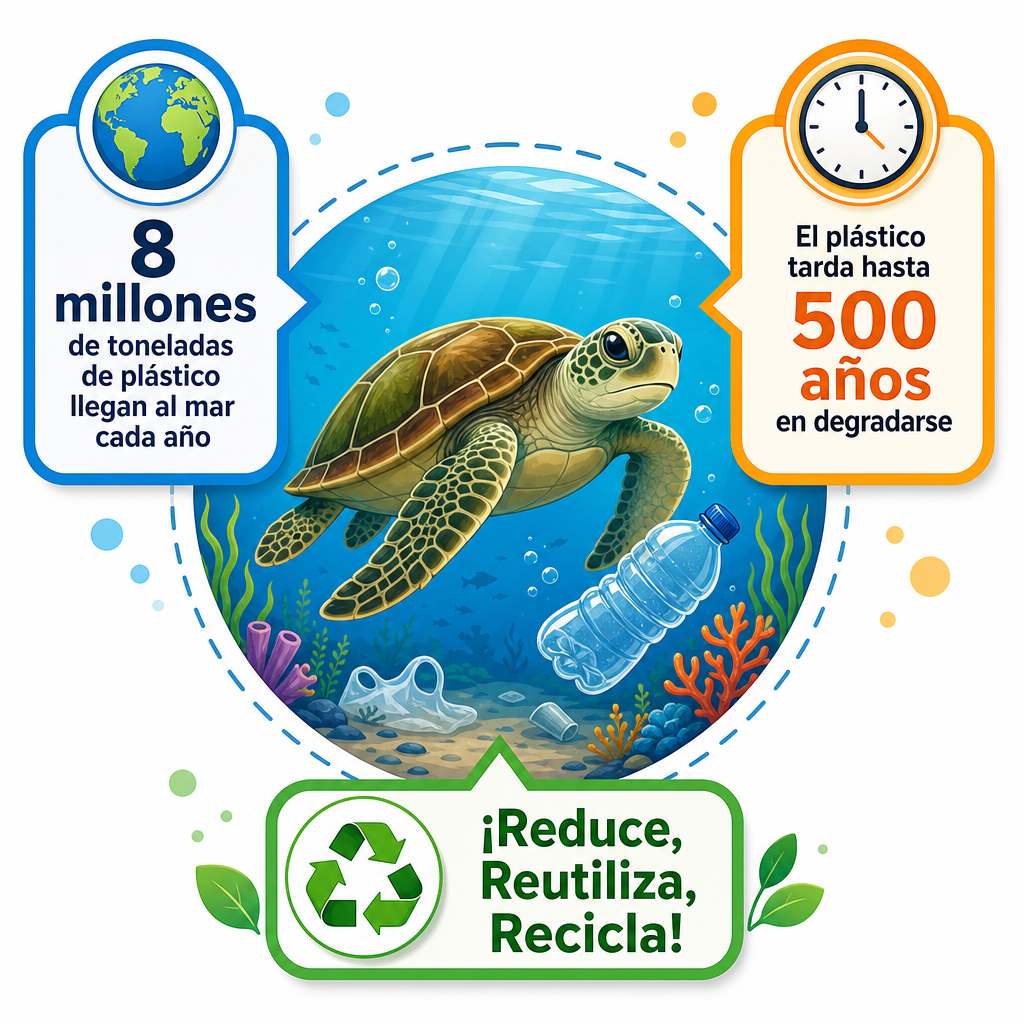
De acuerdo con la imagen adjunta, look at the infographic provided. What is the author's main purpose in creating this document?
Ver respuesta y explicación
Respuesta correcta: C. La infografía muestra datos alarmantes sobre la contaminación por plástico en los océanos y promueve acciones sencillas como reducir, reutilizar y reciclar, por lo que su propósito principal es concientizar al lector.
Pregunta 4IntermedioAnalizar
Read this excerpt from a short story:
'I stared at the classroom door. My hands were shaking, and my stomach felt like it was full of cold stones. It was my first day at this school in Santiago, and I didn't know a single soul. I took a deep breath, trying to convince myself that everything would be fine.'
What is the overall tone of the narrator in this passage?
Ver respuesta y explicación
Respuesta correcta: B. Las pistas de texto como 'hands were shaking' (manos temblando), 'stomach felt like... cold stones' (estómago como piedras frías) y el nerviosismo de no conocer a nadie en su primer día revelan un tono de ansiedad y nerviosismo.
Pregunta 5IntermedioAnalizar
Read the following narrative extract:
'Lucas knew that Sofia had copied the answers during the final English exam. She was his best friend, and she desperately needed to pass to avoid summer school. However, the teacher announced that if the person who cheated didn't confess, the whole class would receive a failing grade. Lucas sat at his desk, staring at the floor, torn between loyalty to his friend and fairness to his classmates.'
What type of conflict is central to this passage?
Ver respuesta y explicación
Respuesta correcta: B. El conflicto es interno ('internal conflict') porque Lucas se encuentra atrapado en un dilema moral personal, debatiéndose entre la lealtad a su mejor amiga y la justicia para con el resto de sus compañeros.
Pregunta 6IntermedioLocalizar información
Read the news snippet below:
'In November 2022, a group of high school students in Temuco started "GreenSchool," an initiative to compost organic waste. By March 2023, they had successfully processed 500 kilograms of waste. The project received national recognition in October of the same year, inspiring five other schools in the Araucanía region to join.'
According to the text, when did the "GreenSchool" project receive national recognition?
Ver respuesta y explicación
Respuesta correcta: C. El texto indica que el proyecto recibió reconocimiento nacional en octubre del mismo año (refiriéndose a 2023, ya que la oración anterior menciona marzo de 2023).
Pregunta 7DifícilEvaluar / Inferir
Read this literary passage:
'When Clara first got her smartphone, she was inseparable from it. Every notification was an urgent call, every post a vital update. But as months passed, she noticed the quiet moments of her life had vanished. One afternoon, she left the phone on her desk and went for a walk in the park near her house. For the first time in a year, she heard the wind in the trees and noticed the color of the autumn leaves. She realized she didn't need to be constantly connected to feel alive.'
How does Clara's character develop or change throughout the passage?
Ver respuesta y explicación
Respuesta correcta: B. El personaje de Clara experimenta una evolución: pasa de estar constantemente conectada y dependiente de su teléfono ('inseparable from it') a desconectarse voluntariamente y valorar la naturaleza y los momentos de paz fuera de la red.
Pregunta 8DifícilAnalizar
Read the following text:
'While some educators argue that artificial intelligence (AI) encourages cheating, we must accept that AI is the future of work. Instead of banning these tools, schools should teach students how to write effective prompts and critically analyze AI-generated outputs. If we fail to integrate AI literacy into our national curriculum, we are sending our graduates into a modern workforce without the necessary tools to survive.'
Based on the text, who is the primary target audience and what is the author's purpose?
Ver respuesta y explicación
Respuesta correcta: C. El texto se dirige a la comunidad educativa ('educators', 'schools', 'national curriculum') y utiliza un tono argumentativo para persuadir sobre la necesidad de integrar la alfabetización en IA en el currículo, lo que coincide con la opción C.
Pregunta 9DifícilEvaluar
Read this paragraph about urban green spaces:
'Santiago currently has an average of 4 square meters of green space per habitant, which is below the World Health Organization's recommendation of 9 square meters. This is a complete tragedy. Our local authorities are doing an awful job because they clearly do not care about our mental health or the environment.'
Which of the following options correctly distinguishes a fact from an opinion in this text?
Ver respuesta y explicación
Respuesta correcta: A. La cantidad de áreas verdes por habitante en Santiago (4m²) es un dato objetivo y medible (Hecho/Fact), mientras que calificar la gestión de las autoridades como 'un trabajo pésimo' ('an awful job') es un juicio de valor subjetivo (Opinión).
Pregunta 10DifícilAnalizar
Read this literary extract:
'The wooden floorboards of my grandfather's house in Valdivia still creaked in the exact same tone as they did ten years ago. I touched the old wooden dining table, feeling the deep scratches we made as children. Outside, the rain beat gently against the window pane. Everything in the house remained frozen in time, yet as I looked at my own reflection in the dusty mirror, I realized that the boy who used to play here was long gone, replaced by a stranger with tired eyes and adult worries.'
Which of the following best describes the central theme of this passage?
Ver respuesta y explicación
Respuesta correcta: B. El texto reflexiona sobre cómo la casa y sus objetos permanecen idénticos, casi detenidos en el tiempo ('frozen in time'), mientras que el narrador ha cambiado profundamente al crecer, dejando atrás su niñez. Esto representa el contraste entre la permanencia física y el cambio humano.