Test: Conditionals, inversion and thematic vocabulary
10 preguntas de selección múltiple · Dificultad: Mixto · Unidad: Language in Use — Advanced Grammar. Elige una alternativa y revisa la explicación.
Pregunta 1FácilAplicar
Choose the option that correctly completes the sentence about environmental sustainability: 'If we ______ our carbon footprint today, future generations will inherit a healthier planet.'
Ver respuesta y explicación
Respuesta correcta: B. This is a first conditional sentence used to talk about real and possible future situations. The structure requires the simple present tense in the 'if-clause' ('reduce') and 'will' + verb in the main clause ('will inherit').
Pregunta 2FácilComprender
Which of the following sentences correctly expresses a regret about past technological development using the third conditional?
Ver respuesta y explicación
Respuesta correcta: B. The third conditional is used to express regrets or hypothetical situations in the past. Its structure is 'If + past perfect' (had regulated) and 'would + have + past participle' (would have avoided).
Pregunta 3FácilAplicar
Complete the statement about human rights: 'Rarely ______ such a passionate defense of democratic values as we did during the global youth summit.'
Ver respuesta y explicación
Respuesta correcta: C. When starting a sentence with a restrictive or negative adverb like 'Rarely', inversion is required. The auxiliary verb 'have' must come before the subject 'we', followed by the past participle 'witnessed'.
Pregunta 4IntermedioAnalizar
Read the following scenario: 'Chile invested heavily in renewable energy sources years ago. As a result, the country enjoys a cleaner energy grid today.' Which mixed conditional sentence best represents this situation?
Ver respuesta y explicación
Respuesta correcta: B. This requires a mixed conditional that links a hypothetical past action (If + past perfect: 'hadn't invested') to a present result (would/wouldn't + infinitive: 'wouldn't enjoy').
Pregunta 5IntermedioAplicar
Complete the formal political statement: 'Not only ______ the new bill to protect digital privacy, but they also pledged to penalize tech giants that violate human rights.'
Ver respuesta y explicación
Respuesta correcta: B. The negative/restrictive correlative conjunction 'Not only' at the beginning of a clause triggers inversion. In the simple past, the auxiliary 'did' is placed before the subject 'the government', followed by the base form of the verb 'pass'.
Pregunta 6IntermedioAnalizar
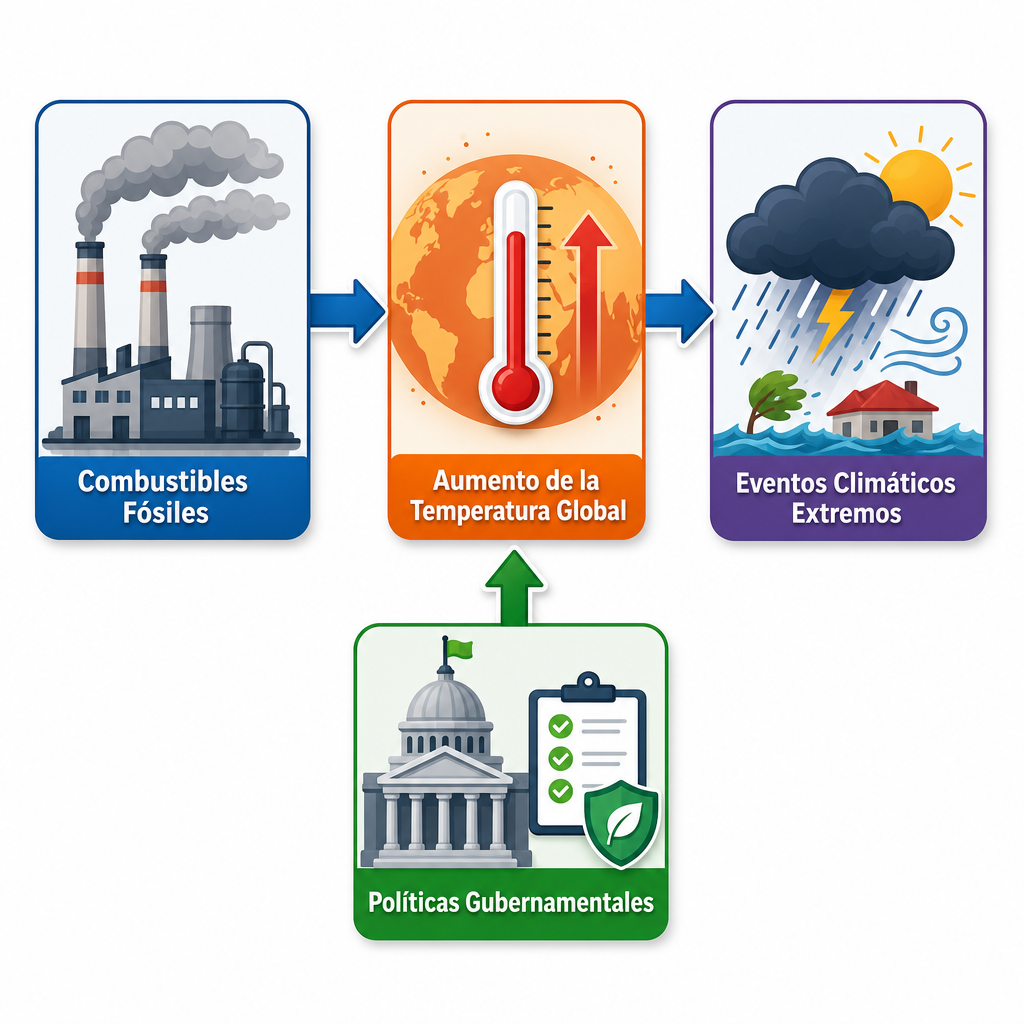
De acuerdo con la imagen adjunta, look at the diagram showing the relationship between human actions, climate change, and global policies. Based on the diagram, which of the following conditional statements is grammatically correct and logically accurate?
Ver respuesta y explicación
Respuesta correcta: B. The mixed conditional 'If we had reduced... we wouldn't be facing...' correctly connects a hypothetical past action (reducing emissions decades ago) with a hypothetical present state (facing extreme weather now), which matches the cause-and-effect flow shown in the diagram.
Pregunta 7DifícilEvaluar
Identify the grammatically correct and most rhetorically effective sentence that uses inversion to emphasize a critical perspective on emerging technologies:
Ver respuesta y explicación
Respuesta correcta: B. The adverbial phrase 'Under no circumstances' requires inversion of the subject and the auxiliary verb. Therefore, 'should we allow' is the correct inverted form. Option C is incorrect due to double negation, and Option D incorrectly uses the past tense 'allowed' after the modal 'should'.
Pregunta 8DifícilAplicar
Complete the following academic argument about political ethics: 'Had the international community intervened during the early stages of the democratic crisis, the country ______ under an authoritarian regime today.'
Ver respuesta y explicación
Respuesta correcta: C. The sentence starts with an inverted third conditional structure ('Had the international community intervened...' equivalent to 'If the international community had intervened...'). Because the result clause refers to the present ('today'), we must use a mixed conditional result clause: 'wouldn't be struggling' (would + be + verb-ing).
Pregunta 9DifícilAnalizar
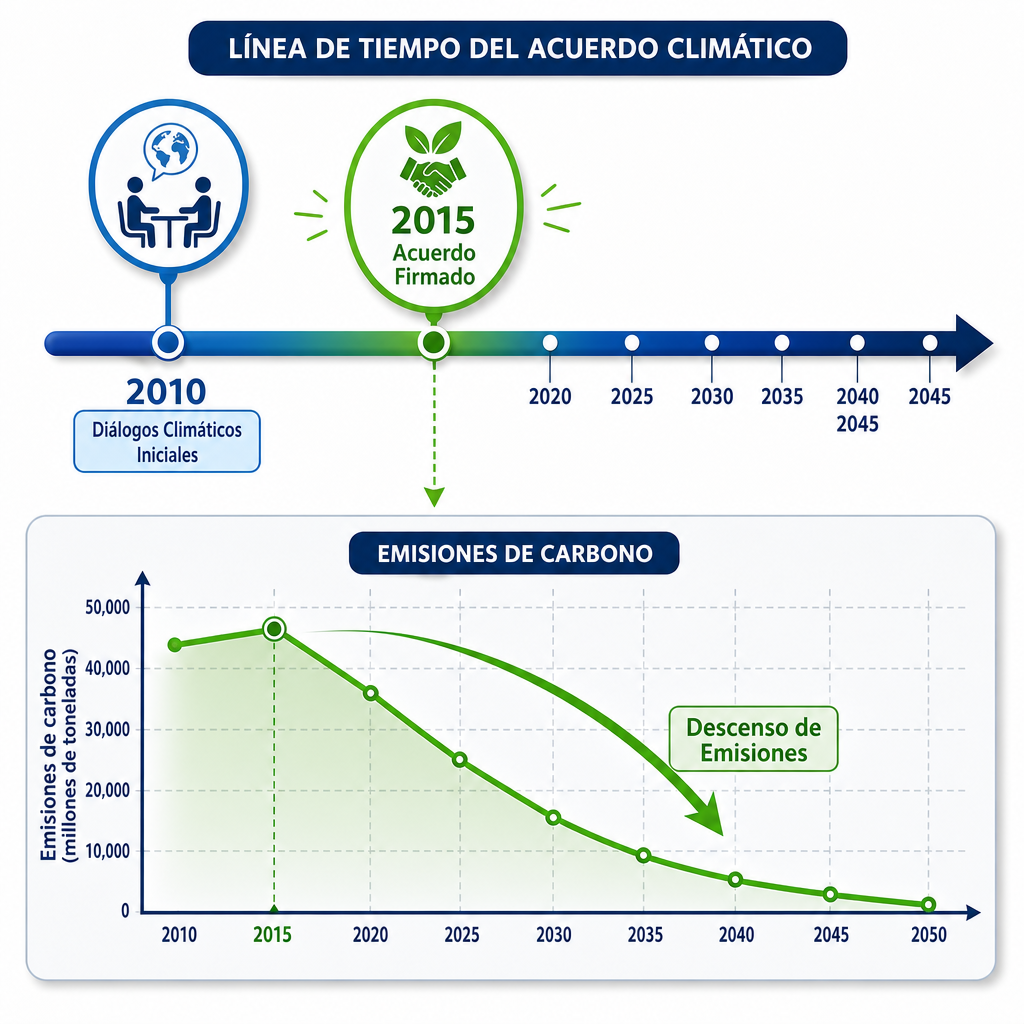
De acuerdo con la imagen adjunta, observe the infographical timeline illustrating the milestones of renewable energy legislation and its impact on carbon emissions. Based on the data and the timeline, which statement correctly employs inversion and accurate thematic vocabulary?
Ver respuesta y explicación
Respuesta correcta: A. The structure 'No sooner... than' is used to show that one event happened immediately after another. When 'No sooner' starts the sentence, inversion is required ('did the government sign' or 'had the government signed'). Option A correctly applies this inversion and matches the timeline's immediate sequence of events.
Pregunta 10DifícilEvaluar
Which of the following options represents the most grammatically precise and sophisticated way to rewrite this sentence: 'If the administration had not ignored the warnings about digital surveillance, citizens' rights would be protected now.'?
Ver respuesta y explicación
Respuesta correcta: A. To invert a negative third conditional clause, we use 'Had + subject + not + past participle'. Contracting 'Hadn't' at the beginning of an inverted conditional (as in Option C) is grammatically incorrect in formal English.